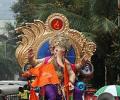
Mahesh Vijapurkar on how the celebrations for Mumbai favourite deity is now a combination of crass commerce and politics.

For the second straight year, the pandemic cast a long shadow on festivities with the Maharashtra government placing a slew of restrictions to avoid gathering and processions.

It is Mumbai's favourite festival and is celebrated each year with fervour and frenzy. But when the city welcomes "Ganpati Bappa" this Friday, the celebrations will be low key. With a cap on the size of idols, ban on processions and restrictions on devotees visiting pandals, celebrations are toned down for the second year in a row. Festival budgets have shrunk and as a result, corporate sponsorships have dried out.
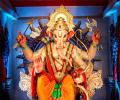
At Ganesh Galli, one of Mumbai's oldest pandals, a team of more than 60 workers came together to create Ayodhya's Ram Mandir.
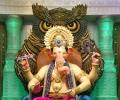
One of the oldest and most revered idol of Lord Ganesh, the Lalbaugcha Raja, was unveiled by the Lalbaug Sarvajanik Ganeshostav mandal in Mumbai on Thursday evening, three days before the Ganesh Chaturthi festival start.

The 10-day Ganesh festival began on Saturday under the shadow of the coronavirus pandemic, with devotees restricting celebrations to their homes and using online platforms to get 'darshan' of the Lord at temples, amid strict COVID-19 restrictions imposed by governments.

The 10-day-long annual Ganesh Chaturthi festival began on a low-key note on Friday with several state governments prohibiting public celebrations due to the Covid pandemic and devotees taking the virtual route to pay obeisance and join the festivities.
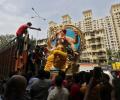
Devotees across India on Thursday welcomed their most beloved and venerated deity -- Lord Ganesh -- into their homes and community pandals, kickstarting the ten-day Ganesh Chaturthi celebrations with zeal and devotion.

We bring you glimpses from one of Mumbai's oldest pandals, Mumbaicha Raja.
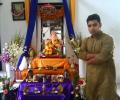
Ganesh Chaturthi no longer has the power that Lokmanya Tilak had seen in it way back in 1893 -- the power of bringing people together. This, say 83-year-old Vinaysheela Govilkar and 19-year-old Arnav Thakker, is the festival's biggest tragedy.

The people out on the streets dancing, and those who fall and get injured are from families that cannot afford to lose a day's wages, but often end up losing a limb or life, says N Suresh.
